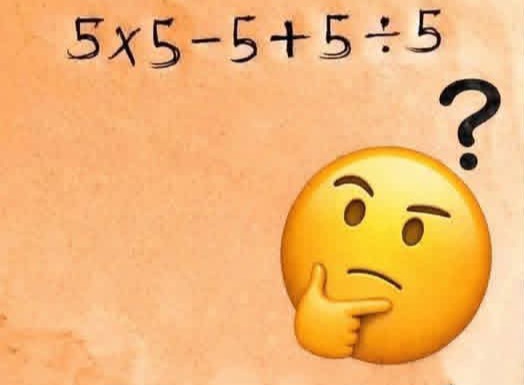
T-hchFont ResizerAaRecipesOnly Geniuses Can Solve This Math Puzzle in 10 Seconds: Can You?Salah RecipesBySalah RecipesPublished July 1, 2026If you spend any time scrolling through social media, you have inevitably encountered a viral math puzzle confidently declaring that “Only a Genius” can solve it.ContentsWhy People Get It WrongThe Golden Key: PEMDAS / BODMASStep-by-Step BreakdownThe Golden Key: PEMDAS / BODMASStep-by-Step BreakdownThe VerdictThe image features one of these exact head-scratchers, presenting a simple, single-row arithmetic equation filled with a sequence of number fives:5×5−5+5÷5=?While the caption claims you need a genius-level IQ to find the answer, the truth is far more reassuring. You don’t need a degree in advanced mathematics to crack this code—you just need a quick refresher on a fundamental rule we all learned in grade school: The Order of Operations.Why People Get It WrongWhen people look at an equation like this one, our natural human instinct is to read it horizontally from left to right, just like a sentence in a book.If you solve it straight across from left to right, here is what happens:5×5=2525−5=2020+5=2525÷5=5This leads many people to confidently type “5” into the comment section. Unfortunately, while it makes logical sense reading left-to-right, mathematically, it is completely incorrect.The Golden Key: PEMDAS / BODMASTo ensure that mathematicians across the globe always get the exact same answer to an equation, the scientific community relies on a strict operational hierarchy. Depending on where you grew up, you likely learned this as an acronym: PEMDAS (Parentheses, Exponents, Multiplication/Division, Addition/Subtraction) or BODMAS (Brackets, Orders, Division/Multiplication, Addition/Subtraction).According to this rule, multiplication and division hold a higher rank than addition and subtraction. Therefore, they mustbe performed first, regardless of where they sit in the line.Step-by-Step BreakdownLet’s apply the order of operations to solve the puzzle correctly.The Golden Key: PEMDAS / BODMASTo ensure that mathematicians across the globe always get the exact same answer to an equation, the scientific community relies on a strict operational hierarchy. Depending on where you grew up, you likely learned this as an acronym: PEMDAS (Parentheses, Exponents, Multiplication/Division, Addition/Subtraction) or BODMAS (Brackets, Orders, Division/Multiplication, Addition/Subtraction).According to this rule, multiplication and division hold a higher rank than addition and subtraction. Therefore, they mustbe performed first, regardless of where they sit in the line.Step-by-Step BreakdownLet’s apply the order of operations to solve the puzzle correctly.Our starting equation is:5×5−5+5÷51Execute Multiplication and DivisionRank 1First, we scan the line and isolate our high-priority operations: the multiplication at the front (5×5) and the division at the end (5÷5).5×5=255÷5=1Now, we substitute those solved values back into our equation, keeping the remaining operational signs exactly where they were. The equation now reads:25−5+12Solve Addition and Subtraction Left to RightRank 2Now that we are left only with addition and subtraction, these two operations hold equal weight in the mathematical hierarchy. When operators have the same rank, you resolve them in standard left-to-right order.First, handle the subtraction on the left: 25−5=20This leaves us with: 20+13Arrive at the True ResultFinal AnswerFinally, perform the final addition step:20+1=21The VerdictThe definitive mathematical answer to the puzzle is 21.Memes like are brilliant engagement traps because they exploit our tendency to forget basic school rules when scanning a screen quickly. It turns out you don’t need a genius mind to conquer the comment section—just a steady application of standard arithmetic rules!!
Search Results for: Only Geniuses Can Solve This Math Puzzle in 10 Seconds: Can You?